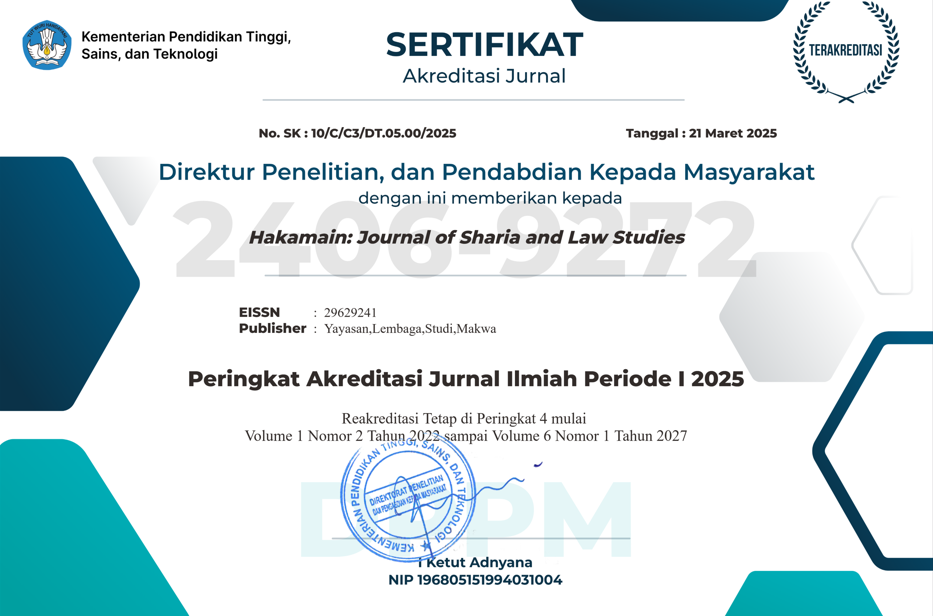
Constitutional Reconstruction of the Relationship Between the President and the DPD in Indonesia’s Asymmetric Bicameral System
DOI:
https://doi.org/10.57255/hakamain.v3i2.1777Keywords:
DPD, asymmetric bicameral system, President, institutional relations, regional autonomy, constitutional reform, 1945 ConstitutionAbstract
This article examines the institutional relationship between the President of the Republic of Indonesia and the Regional Representatives Council (DPD) within the framework of the asymmetric bicameral system adopted by Indonesia following the amendments to the 1945 Constitution. The study positions the DPD within two relationships simultaneously: a vertical relationship with the President as head of government, and a horizontal relationship with the People’s Representative Council (DPR) as the dominant chamber in the representative system. This article argues that Indonesia’s highly asymmetric bicameral structure has reduced the DPD to an institutionally marginal body, lacking meaningful checks and balances against either the executive or the DPR. The analysis includes a constitutional review of the DPD’s powers, a comparative analysis with bicameral systems in other countries, an empirical evaluation of the DPD’s effectiveness, and a series of recommendations for constitutional reforms necessary to transform the DPD into a substantive institution of regional representation.
References
Asshiddiqie, Jimly. (2006). Pengantar Ilmu Hukum Tata Negara. Jakarta: Sekretariat Jenderal dan Kepaniteraan MK RI.
Haris, Syamsuddin (Ed.). (2019). Masalah-Masalah Demokrasi dan Kebangsaan Era Reformasi. Jakarta: Yayasan Obor Indonesia.
Indrayana, Denny. (2008). Amandemen UUD 1945: Antara Mitos dan Pembongkaran. Bandung: Mizan.
Lijphart, Arend. (1999). Patterns of Democracy: Government Forms and Performance in Thirty-Six Countries. New Haven: Yale University Press.
Manan, Bagir. (2003). DPR, DPD, dan MPR dalam UUD 1945 Baru. Yogyakarta: FH UII Press.
Norton, Philip (Ed.). (1990). Legislatures. Oxford: Oxford University Press.
Patterson, Samuel C. & Mughan, Anthony (Eds.). (1999). Senates: Bicameralism in the Contemporary World. Columbus: Ohio State University Press.
Peraturan DPD RI tentang Tata Tertib (versi terkini).
Putusan Mahkamah Konstitusi Nomor 92/PUU-X/2012, perihal Pengujian UU MD3 atas kewenangan DPD.
Tsebelis, George & Money, Jeannette. (1997). Bicameralism. Cambridge: Cambridge University Press.
Undang-Undang Dasar Negara Republik Indonesia Tahun 1945 (Amandemen Pertama s.d. Keempat, 1999–2002).
Undang-Undang Nomor 1 Tahun 2022 tentang Hubungan Keuangan antara Pemerintah Pusat dan Pemerintahan Daerah.
Undang-Undang Nomor 17 Tahun 2014 tentang MD3 sebagaimana diubah dengan UU No. 13 Tahun 2019.
Undang-Undang Nomor 23 Tahun 2014 tentang Pemerintahan Daerah.
Zoelva, Hamdan. (2011). Pemakzulan Presiden di Indonesia. Jakarta: Sinar Grafika.

Downloads
Published
How to Cite
Issue
Section
Citation Check
License
Copyright (c) 2026 Irmanjaya Thaher, Markoni, Dzaki M. Ihsan

This work is licensed under a Creative Commons Attribution-ShareAlike 4.0 International License.