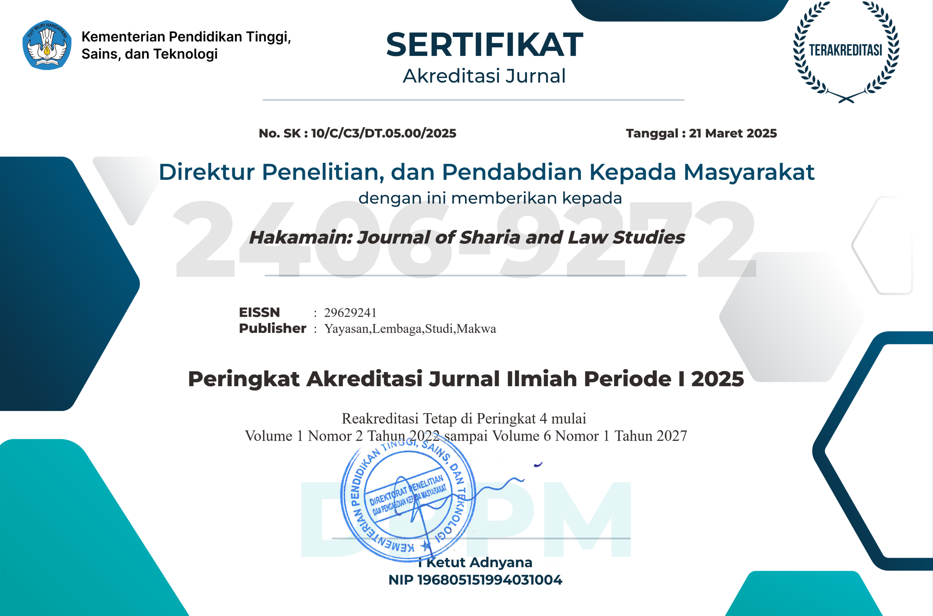
Meritocracy and the Politicization of Supreme Court Justice Recruitment: An Evaluation of the Judicial Commission’s Independence in 2024
DOI:
https://doi.org/10.57255/hakamain.v1i2.1766Keywords:
Judicial Commission, independence, Supreme Court justice recruitmentAbstract
This article examines the independence of the Judicial Commission (KY) in the recruitment process for Supreme Court justices, focusing on the 2024 selection data. In that selection process, 143 individuals applied for the positions of 2 Supreme Court justices in the Civil Chamber, 3 in the Criminal Chamber, 1 in the Religious Chamber, 1 in the Administrative Law Chamber, and 3 in the Special Tax Administrative Law Chamber. Of the 143 applicants, 133 passed the administrative screening. The selection process resulted in 19 Supreme Court justice candidates and 3 ad hoc human rights judge candidates being approved by the KY, as outlined in Announcement No. 11/PENG/PIM/RH.04.06/07/2024. This study examines the constitutional and normative foundations of the KY’s authority, the stages of the selection process and mechanisms for ensuring independence, the challenges faced by the KY in maintaining its independence, and an analysis of the distribution of positions that reflects the institutional needs of the Supreme Court. This article also evaluates the institutional relationship between the Judicial Commission, the House of Representatives, and the Supreme Court within the Supreme Court justice recruitment process, and formulates recommendations to strengthen the Judicial Commission’s institutional independence
References
Asshiddiqie, Jimly. (2006). Pengantar Ilmu Hukum Tata Negara. Jakarta: Sekretariat Jenderal MK RI.
Butt, Simon & Lindsey, Tim. (2012). The Indonesian Constitution: A Second Opinion. Sydney: Federation Press.
Ferejohn, John & Pasquino, Pasquale. (2004). Constitutional Adjudication: Lessons from Europe. Texas Law Review, 82(7), 1671–1704.
Hamdan Zoelva. (2011). Pemakzulan Presiden di Indonesia. Jakarta: Sinar Grafika.
Komisi Yudisial RI. (2024). Laporan Tahunan Komisi Yudisial 2024. Jakarta: Sekretariat Jenderal KY RI.
Komisi Yudisial RI. (2024). Pengumuman Nomor 11/PENG/PIM/RH.04.06/07/2024 tentang Hasil Seleksi Calon Hakim Agung dan Calon Hakim Ad Hoc HAM. Jakarta: KY RI.
Mahkamah Agung & KY. (2009). Pedoman Perilaku Hakim. Jakarta: MA-KY.
Mahkamah Agung RI. (2024). Laporan Tahunan Mahkamah Agung 2024. Jakarta: MA RI.
Nicos Alivizatos. (1995). Judges as Veto Players. Dalam Arend Lijphart & Carlos H. Waisman (Eds.), Institutional Design in New Democracies. Boulder: Westview Press.
Peraturan Komisi Yudisial tentang Tata Cara Seleksi Calon Hakim Agung.
Siahaan, Maruarar. (2011). Hukum Acara Mahkamah Konstitusi RI (Edisi Kedua). Jakarta: Sinar Grafika.
Undang-Undang Dasar Negara Republik Indonesia Tahun 1945 (khususnya Pasal 24, 24A, 24B).
Undang-Undang Nomor 14 Tahun 1985 tentang Mahkamah Agung sebagaimana diubah dengan UU No. 5 Tahun 2004 dan UU No. 3 Tahun 2009.
Undang-Undang Nomor 22 Tahun 2004 tentang Komisi Yudisial sebagaimana diubah dengan UU No. 18 Tahun 2011.
Undang-Undang Nomor 26 Tahun 2000 tentang Pengadilan Hak Asasi Manusia.
Undang-Undang Nomor 48 Tahun 2009 tentang Kekuasaan Kehakiman.
Voermans, Wim. (2007). Councils for the Judiciary in EU Countries. Tilburg: Tilburg University Press.

Downloads
Published
How to Cite
Issue
Section
Citation Check
License
Copyright (c) 2022 Irmanjaya Thaher, Dzaki M. Ihsan, Gerry Joe

This work is licensed under a Creative Commons Attribution-ShareAlike 4.0 International License.